
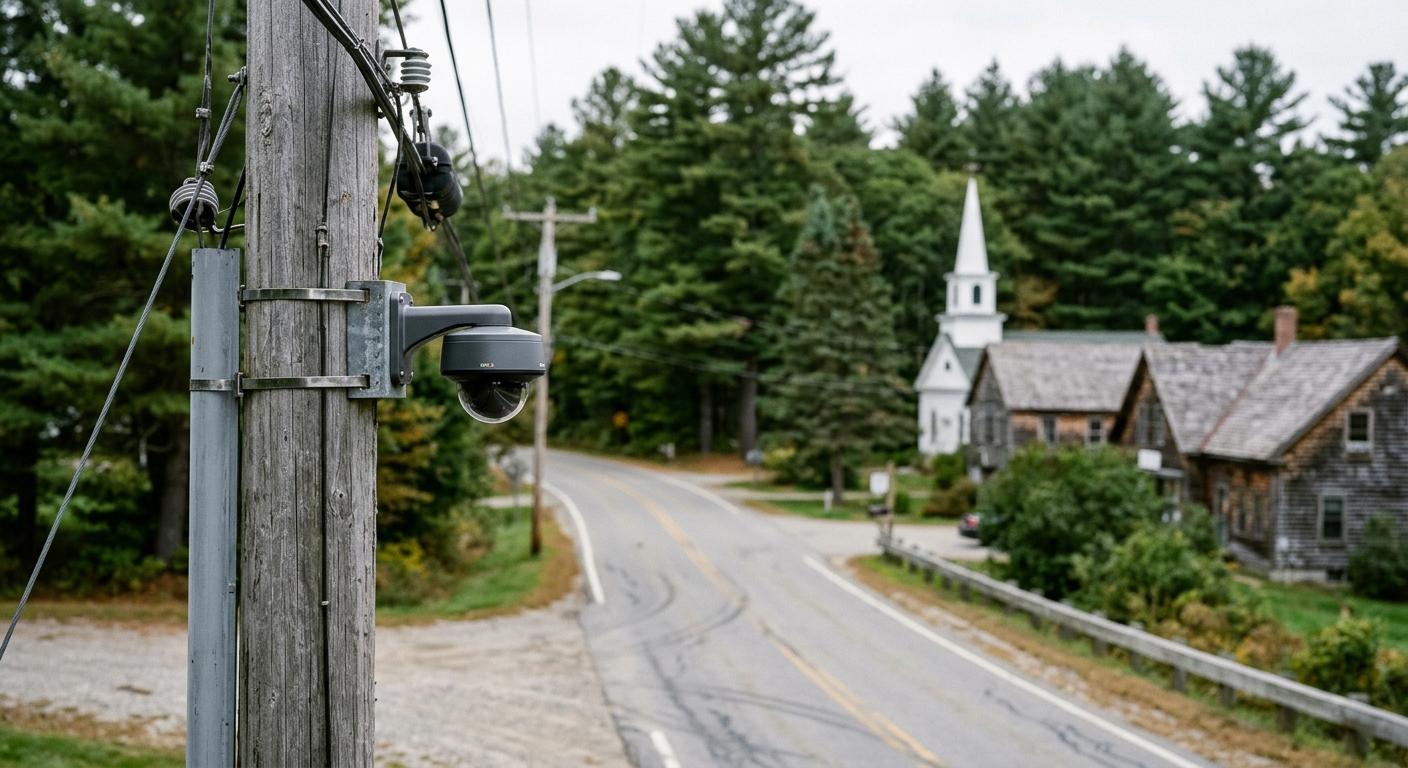
AI-generated illustration; not a photograph of the reported event.
- calendar_today October 25, 2026
Manchester Faces Upcoming Vermont Ban on Automated License Plate Readers
At the latest selectboard meeting in Manchester, town leaders and residents discussed the future of automated license plate recognition technology amid Vermont’s forthcoming statewide ban. The town’s contract with Flock, a provider of automated license plate reader (ALPR) systems, is due to expire in March, ahead of the state’s legislative prohibition set for July 1, 2027.
Vermont Legislation Spurs Search for Alternatives
The relevant statute, 23 V.S.A. § 1609, will soon prevent any state agency or subdivision from using automated license plate recognition systems or automated traffic law enforcement systems. Manchester had initially paused its use of the Flock camera system pending review by the Agency of Transportation, as the cameras were first intended for work-zone traffic safety rather than broad law enforcement. Use resumed in February after Transportation Secretary Joe Flynn clarified the town’s current deployment was allowed under existing law, following consultation with the Department of Public Safety about data handling.
Chief Blanchard Outlines Law Enforcement’s Perspective
Chief of Police James Blanchard expressed concern over potentially losing ALPR technology, calling it “a valuable investigative tool.” In an October 15 email to Town Manager Scott Murphy, Blanchard recommended seeking updated state guidance before investing in any replacement system. He highlighted the importance of researching alternatives, noting the need for a solution that aligns with both legal requirements and the board’s expectations while maintaining public safety capabilities.
Unify Camera System Considered as a Potential Replacement
During the public meeting, Blanchard discussed the Unify Camera System — currently used on the exterior of the town’s public safety building — as a possible alternative. One advantage of Unify, he noted, is its ability to store data locally on town-owned equipment rather than relying on vendor-managed cloud services, addressing a key privacy concern. However, Blanchard identified challenges including cost, data transmission logistics, and whether the system could provide the required policing functions. Power supply was another consideration, as the existing Flock cameras are solar-powered, while a hardwired system may be preferable but would require further research.
Community and Selectboard Reactions: Balancing Safety and Privacy
Community sentiment was voiced by Peter Campbell, owner of The Crooked Ram restaurant, who described how news of the town’s surveillance technology has eroded trust in local government and law enforcement among residents who valued Manchester for its sense of community. Board member Jonathan West cautioned against hasty adoption of new technology, raising concerns about artificial intelligence, the dangers of centralizing sensitive data with private corporations, and potential system exploits. He emphasized the importance of local control, transparency, and public trust in how surveillance and law enforcement technology is deployed.
Calls for Public Education and Transparency
Select Board Vice Chair Heidi Chamberlain stressed the need to educate the public on the reasoning behind adopting such technology and to differentiate the town’s intentions from negative examples seen elsewhere. She noted the rapidly evolving landscape of AI and surveillance and affirmed that the selectboard is actively responding to concerns, having held several meetings on the issue.
Looking Ahead: Next Steps for Manchester
With the Flock contract nearing expiration and a legislative ban on the horizon, Manchester officials are weighing options for maintaining public safety while respecting new state requirements and resident concerns regarding privacy and surveillance. Research into alternative systems, such as the Unify Camera System, continues as the town seeks a balanced approach to law enforcement technology in the face of changing regulations and public expectations.
Source: vtdigger.org.


