- calendar_today August 16, 2025
.
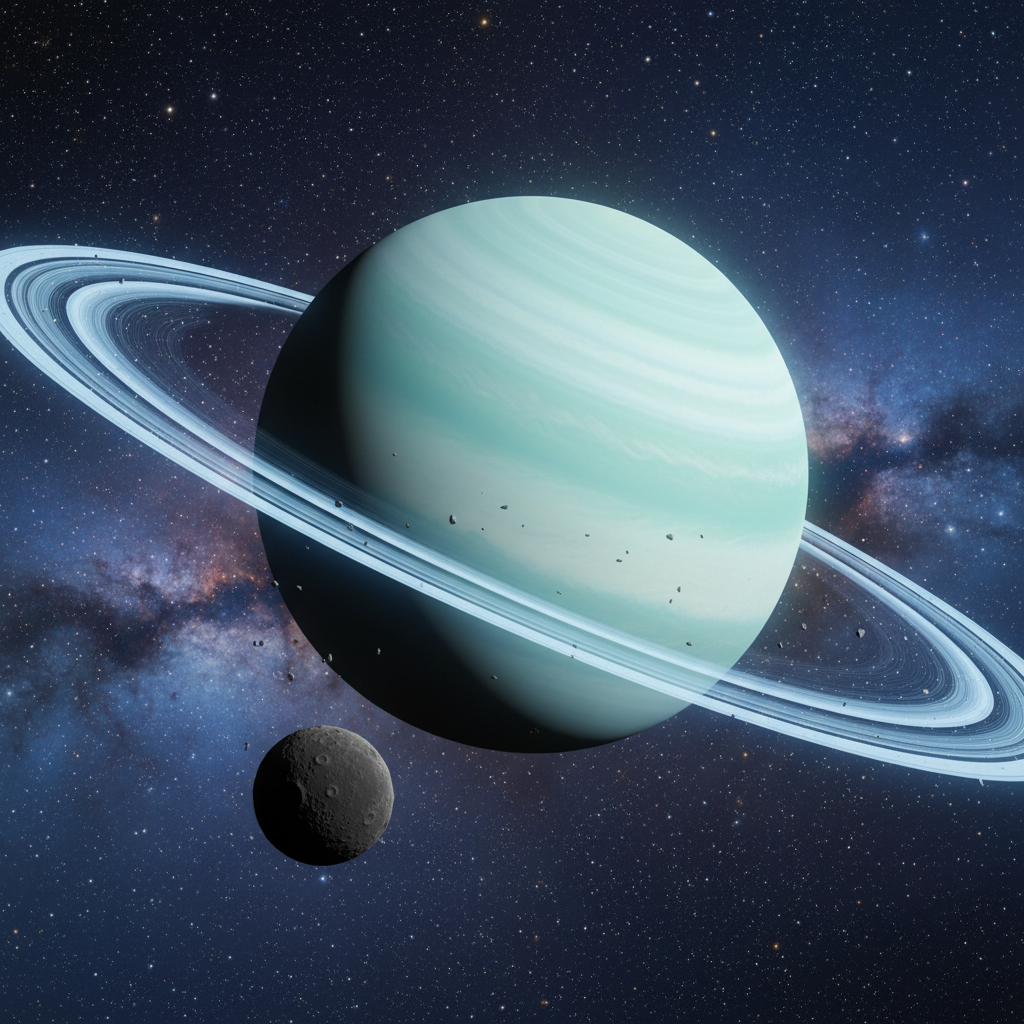
The James Webb Space Telescope (JWST) has uncovered a mysterious moon orbiting Uranus that had eluded detection by previous spacecraft and telescopes.
The new moon is one of Uranus’ smallest known natural satellites and brings its total count to 29, according to a news release issued July 24 by the Space Telescope Science Institute in Baltimore, Maryland, which manages the Webb program for NASA.
Moon number 30 may be in the offing, along with many more smaller satellites that likely remain hidden around Uranus, a planet with an already large and active family of moons. “With this discovery, we are getting much better sensitivity in detecting small, dark moons than ever before. We are not done with this moon system yet,” said study lead author Maryame El Moutamid.
A solar system scientist at the Southwest Research Institute’s Solar System Science and Exploration Division in Boulder, Colorado, El Moutamid is also principal investigator of the Webb program to study Uranus’ rings and inner moons.
Unveiled in a series of 40-minute long-exposure images taken by Webb’s Near-Infrared Camera on February 2, the 6-mile-wide (10 kilometers) newly found satellite may be even smaller than it appears, El Moutamid reported in a paper submitted for publication in the Astronomical Journal.
The small size of the new moon and the strong glare from Uranus’ rings likely hid the tiny satellite from view. NASA’s Voyager 2 spacecraft, which made the first-ever close flyby of Uranus 39 years ago, also missed it.
“This is a small moon, but still a significant discovery,” El Moutamid said. She highlighted the breakthrough and the progress Webb will make in understanding the outer solar system. “Webb is taking us much farther than the missions we had in the past,” she said.
A Temporary Name and Orbit
The moon’s provisional designation is S/2025 U1, with “S” indicating a satellite of Uranus, “2025” denoting the year of its discovery, and “1” suggesting that additional satellites will likely be found in the system.
S/2025 U1 is about 35,000 miles (56,000 kilometers) from the center of Uranus and orbits just outside the planet’s bright main ring system. It follows a nearly circular orbit in the planet’s equatorial plane, between the known moons Ophelia, just beyond Uranus’ main ring system, and Bianca. It’s possible the moon formed in this vicinity, El Moutamid suggested.
Astronomers had a tough time peeling the new moon away from Uranus and its rings. The small, dark satellite zips around the planet at high speed and, for this reason, its presence was invisible to previous telescopes and spacecraft. But Webb is capable of detecting very faint infrared light and could separate the moon’s light signature from that of Uranus and its rings.
Webb has already given astronomers a peek at the planet’s rings and an initial look at the weather and atmosphere of Uranus. Its image of S/2025 U1 is the third discovery of a small moon or planet made by Webb in just a few weeks. Astronomers previously discovered a new exoplanet orbiting a nearby star and a new moon orbiting Neptune.
Searching for Smaller Moons
Uranus already has five major moons — Miranda, Ariel, Umbriel, Titania, and Oberon — plus a collection of smaller ones. With its newly spotted moon, Uranus now has 14 small moons in its inner system. It’s the only planet in the solar system with so many small inner moons all clustered so close together. Astronomers don’t know why. The moons are packed so tightly that their orbits should cross, yet they remain locked in place. The satellites might act as shepherds, preventing Uranus’ narrow rings from spreading out too far.
“With this discovery, we are getting much better sensitivity in detecting small, dark moons than ever before. We are not done with this moon system yet,” said lead author Maryame El Moutamid.
Scott Sheppard, an astronomer at the Carnegie Institution for Science who was not involved in the new study but co-discovered a Uranus moon in 2024, called the discovery “very exciting.” He told Space.com that Webb is so sensitive that astronomers can now use it to find new moons around gas giants. “The fact that this object is associated with Uranus’ inner ring system makes it particularly noteworthy,” he said.
The SETI Institute’s Matthew Tiscareno, Webb Uranus co-principal investigator, said in the news release that this discovery of a moon orbiting Uranus calls attention to “the blurry boundary between Uranus’ moons and its rings. Their complex inter-relationships hint at a chaotic history.”
Size and Surface Characteristics
The newly discovered moon is even smaller and fainter than the smallest known Uranian inner moons. S/2025 U1 has a diameter of 6 miles (10 km), compared with the smallest Uranian inner moons, which range from 8 to 10 miles (12 to 16 km) in diameter. The ring system of Uranus also comprises small bodies. The new moon also has a surface darker than asphalt, but astronomers don’t yet know if the object is one solid body or a rubble pile.
Inner moons, which are typically a mix of ice and rock, are different from the outer moons found beyond Oberon, which are thought to be captured asteroids.
The discovery also adds a new moon to Uranus’ retinue. The moon also raises questions about the origin of Uranus’s ring system. Did S/2025 U1 have a role in making the rings, or was it perhaps a fragment from a prehistoric event that also created the rings? El Moutamid asked. “The discovery raises questions about how many more small moons remain hidden around Uranus and how they interact with its rings,” she explained.