- calendar_today August 25, 2025
.
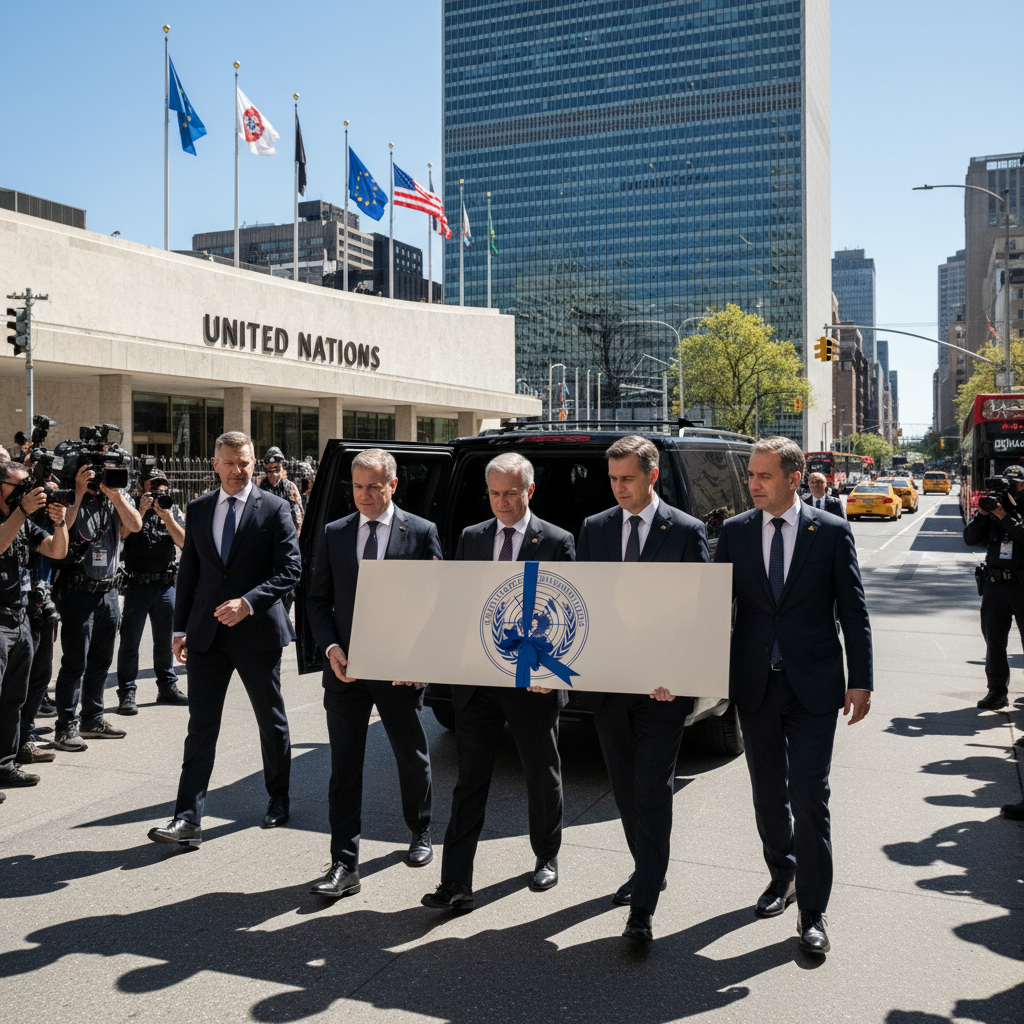
German, French and British officials have said they will trigger the snapback process, reinstating UN sanctions on Iran. European Union diplomats said Wednesday that a joint letter would be delivered to the United Nations, which will then have to give countries 24 hours to vote against snapback.
The European trio “are likely to start the so-called ‘snapback’ mechanism that will lead to the automatic re-imposition of UN sanctions on Tehran, the officials said,” CNN reported.
Iran has threatened “reciprocal actions” against the move, including leaving the International Atomic Energy Agency (IAEA).
The United States left the Joint Comprehensive Plan of Action (JCPOA) – the 2015 Iran nuclear deal – in May 2018. Former US president Donald Trump unilaterally withdrew from the deal and reimposed unilateral sanctions on Iran.
Europe has been negotiating with Iran in an attempt to revive the deal. There have been several rounds of talks in Vienna between the remaining JCPOA members and Iran this year, but with no deal reached.
European foreign ministers met to discuss Iran on Tuesday and had coordinated with the US secretary of state, Antony Blinken, on their actions ahead of the meeting.
Germany, France and the UK all expressed regret at the lack of progress in the Vienna talks and had concluded that Iran was unwilling to return to the JCPOA.
Under the JCPOA, the snapback mechanism allows members to reinstate sanctions in the event of Iranian violations of the deal, CNN said. The mechanism will expire on October 22, 2023.
The current JCPOA sets limits on Iran’s nuclear program and grants it access to civilian nuclear technology. The US withdrawal left the deal in tatters, and with sanctions reimposed on Iran, the other parties to the JCPOA continued negotiations with the hope of keeping Iran within the framework.
Sanctions Snapback Process Explained
CNN reports that the snapback process “could begin as early as Thursday under a provision written into the original deal. It involves transmitting a letter to the UN Security Council, which then has to allow for 24 hours for members to respond and either support or oppose the move.”
The sanctions process takes 30 days to be reimposed, which “creates a narrow window for diplomacy” as the Europeans hope that Tehran may return to the negotiating table in that time.
In addition to the European negotiations, IAEA inspectors have been trying to meet with Iranian officials to discuss the state of Iran’s nuclear program, which Tehran has said is peaceful but has been growing in recent years.
Analysts and IAEA inspectors have said that the program is now at a point where it is fast approaching weapons-grade status.
IAEA Director-General Rafael Grossi was in Washington on Wednesday to discuss Iran’s nuclear program and its relationship with the IAEA. The IAEA confirmed that inspectors had been at Bushehr on Wednesday.
Grossi on Wednesday said that it would be “almost impossible” to return to the original JCPOA. The sanctions snapback is “a very powerful piece of leverage on the Iranian regime,” US secretary of state Marco Rubio said ahead of a meeting with his European counterparts.
Rubio said that the sanctions snapback was “the appropriate diplomatic response” and that it was possible to return to negotiations with Tehran after it had taken effect.
He and Blinken had both been negotiating with Iran and the other JCPOA members before the recent outbreak of hostilities between Iran and Israel.
Inspection Team Returns to Iran
Iran’s parliament in June had passed a law suspending the IAEA’s monitoring of Iran’s nuclear facilities. In early August, IAEA inspectors were allowed to return to the Bushehr power plant in the country’s southwest.
Grossi said Wednesday that the IAEA was “inspecting Bushehr today.” He added that the agency “continues the conversation so that we can go to all places, including the facilities that have been attacked.”
IAEA safeguards in Iran are part of the country’s Nuclear Non-Proliferation Treaty (NPT) commitments, to which Iran has signed up. Grossi had met with Iran’s Atomic Energy Organization chief, Mohammad Eslami, on July 28 in Tehran. Eslami had said that the IAEA was welcome in Iran “except for Bushehr nuclear power plant.”
Iran is now weighing its options in the event of the snapback coming into effect and is reportedly considering pulling out of the NPT.
Iranian foreign minister Abbas Araghchi has said that the parliament decision does not represent a halt in relations with the IAEA and that the IAEA was in Bushehr “with the objective of supervising the replacement of fuel in this reactor.”
He also denied that Iran had given the agency a “green light for a new cooperation.”
Heightened Tensions
Israeli strikes on Iran’s nuclear facilities in June began a 12-day conflict. Iran retaliated with rocket attacks on Israeli cities, and US forces entered the fray on the last day of the conflict by striking three Iranian sites in Syria and Iraq.
The IAEA pulled its inspectors out of Iran in July, citing the state of the war. A separate strike had targeted Iran’s Isfahan Nuclear Technology Research Center in April, according to satellite images.
The IAEA had said in June that Iran was not complying with some safeguard rules, and Iran has accused the agency of aiding Israel’s attack by publicizing that information.
Iran Parliamentary Dissent
The decision to allow IAEA inspectors to return to Bushehr has also caused internal criticism in Iran. Kamran Ghazanfari, a member of Iran’s parliament, criticized speaker Mohammad Bagher Ghalibaf for making remarks “in favor of partial inspections by the IAEA in Iran.”
Ghalibaf had said on Wednesday that allowing IAEA inspectors to continue to visit Bushehr was not an “authorization” of monitoring of other sites. Ghazanfari said Ghalibaf’s comments were “in clear contradiction with the articles and instructions of the parliament’s motion” and “an explicit violation of the law.”
Iran’s parliament had passed the measure that suspended IAEA cooperation in the immediate aftermath of the Israeli attacks.
Tehran had said at the time that the move was to “preserve the rights of the Iranian people against the aggression and the biased and unprofessional reports” of the IAEA.