- calendar_today August 21, 2025
Generative artificial intelligence advancements push mobile technology towards a fundamental shift while standing at a transformative threshold. Current advanced AI systems depend on powerful remote servers for their operations, but Google aims to bring these capabilities to smartphones shortly. The imminent Google I/O event has generated significant interest because Google appears poised to introduce new developer APIs designed to leverage their Gemini Nano model for processing AI tasks directly on devices. Through this strategic decision, Google demonstrates its dedication to delivering advanced AI capabilities directly to users while enhancing privacy protection and performance by reducing cloud dependency.
Insights from Google’s developer documentation now provide developers with a preview of upcoming AI enhancements. Android Authority investigative reports state that the upcoming ML Kit SDK update will introduce API support for on-device generative AI capabilities built on the Gemini Nano model. The innovative framework builds on Google’s AI Core, which serves as a foundational layer similar to the experimental Edge AI SDK but stands out for its smoother user experience. This framework combines with an existing model and provides developers with explicit features to ease implementation and extend advanced AI functionalities to more mobile app developers.
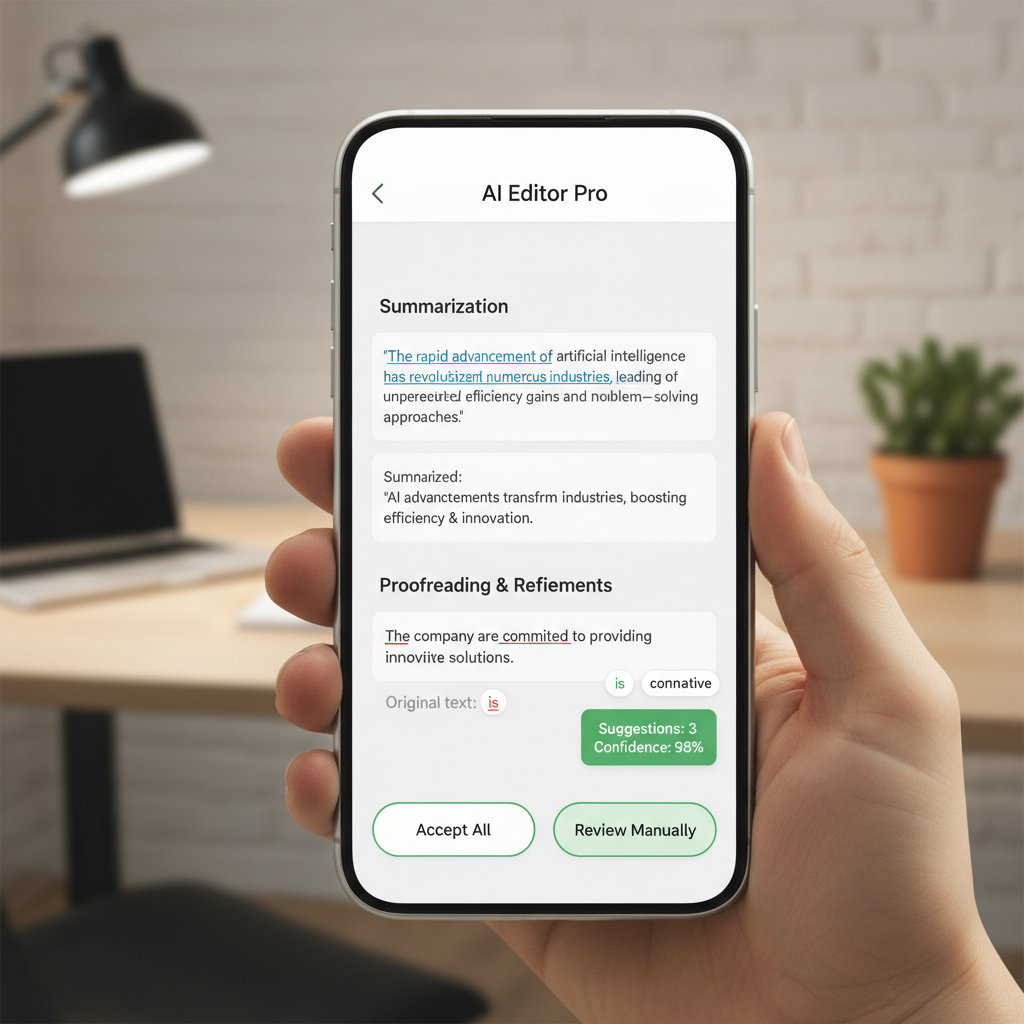
Google provides comprehensive documentation that explains how new ML Kit GenAI APIs enable apps to process sensitive user data locally without using cloud-based systems. These capabilities include:
- Text Summarization: Text Summarization enables the transformation of extensive textual material into brief and comprehensible summaries.
- Proofreading: The proofreading feature detects grammar mistakes and typos while also providing suggestions to fix them.
- Rewriting: The service provides users with different ways to phrase their writing, along with stylistic improvements to improve written communication.
- Image Description: Developing automatic systems that produce written descriptions that precisely reflect image content.
The native processing power limitations of mobile devices require specific constraints to be placed on the Gemini Nano version used on these devices. The text summaries will be limited to three bullet points, while initial support for image description capabilities will be available only in English. The output quality from Gemini Nano AI can vary depending on which version of Gemini Nano is implemented in each smartphone model. The standard Gemini Nano XS model maintains a compact size of about 100MB, and the more efficient Gemini Nano XXS version found in devices like the Pixel 9a uses only 25MB of that space while being limited to text processing and a reduced context window.
Implications for the Android Ecosystem
Google’s strategic shift brings substantial effects to the wider Android ecosystem because the ML Kit SDK supports devices beyond Google’s proprietary Pixel lineup. Prominent Android manufacturers such as OnePlus with their upcoming 13 series, Samsung with their anticipated Galaxy S25, and Xiaomi with their forthcoming 15 series reportedly plan to engineer their next-generation devices to natively support Gemini Nano, as Pixel smartphones currently extensively use this on-device AI model. Developers will reach broader audiences through generative AI-powered features as more Android smartphones gain compatibility with Google’s local AI model, which will lead to smarter and more user-focused mobile experiences across multiple brands and devices.
The current environment makes it difficult for Android app developers who want to implement on-device generative AI in their applications. The experimental AI Edge SDK from Google enables access to the Neural Processing Unit (NPU) for AI model execution, but its limitation to Pixel 9 devices, along with its text-focused processing capabilities, restricts its broad application. Proprietary APIs from companies like Qualcomm and MediaTek provide solutions for AI workload management, but developers face complexity when relying on these APIs due to varying features and functionalities across chipsets and devices. The development and deployment of custom AI models require extensive knowledge about generative AI systems because of their complexity. These novel APIs built from Gemini Nano functionality will democratize local AI tools by enabling simpler deployment for wider developer audiences, which will boost innovation in mobile application development.