- calendar_today August 15, 2025
Sil Still Stuns: Species Turns 30
The news earlier this month that actor Michael Madsen had died was met with a predictable outpouring of grief and remembrance from Hollywood. The actor, who worked prolifically over the last four decades, was most closely associated with memorable, hard-edged roles in Reservoir Dogs, Kill Bill, and Donnie Brasco. But among the many, many fans who reached out to share their favorite Madsen roles, few mentioned a lesser-known, weird turn in a 1995 sci-fi thriller called Species. The film, which turns 30 this year, was an in-your-face creature feature that earned legions of fans during the 90s—and was a reminder that originality was possible, even during an age when monster movies and alien paranoia seemed to outnumber people and jobs.
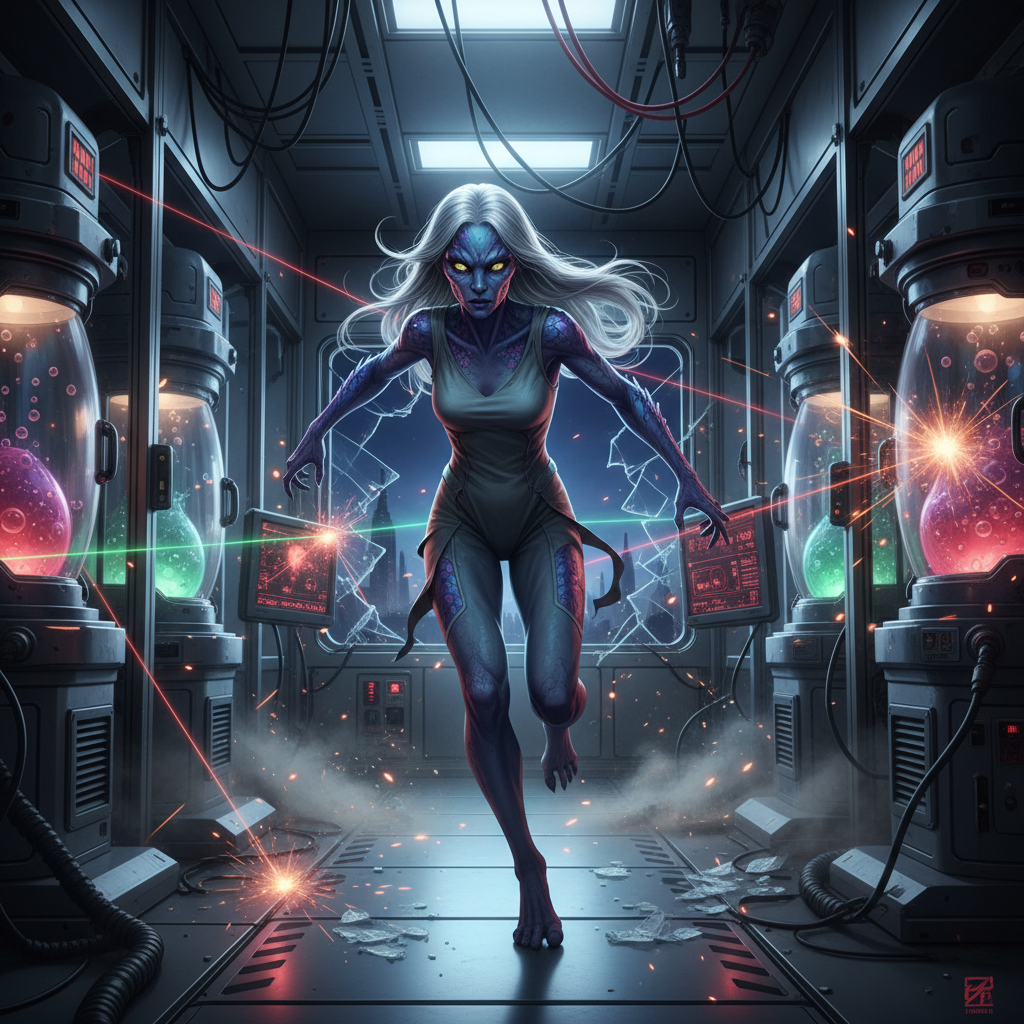
Species, which was directed by Roger Donaldson (No Way Out, The Bounty), was a mishmash of old-fashioned horror, action, and soft science fiction. (In interviews, screenwriter David Twohy described it as a “real-time horror movie set in outer space.”) The story is set into motion when the U.S. government intercepts two transmissions from space. One describes a revolutionary new fuel source; the other contains detailed information on how to combine alien DNA with human DNA. Predictably, they do the latter. Helmed by Dr. Xavier Fitch (Ben Kingsley), they create a hybrid organism: Sil, as she is called. In her preteen stage, she is played by Michelle Williams.
The hybrid was supposed to be a controllable being. Instead, what the government created was an experiment gone wrong. Sil matures at three times the rate of a normal child, but within months, it’s apparent that all is not well. She has violent nightmares, and her behavior begins to point to the conclusion that she may be less “controllable” than originally believed. When Fitch tries to kill Sil by pumping cyanide into her holding cell, she instead escapes, and the die is cast.
To bring her back, Fitch assembles a group of specialists that includes Preston Lennox (Michael Madsen), a hardboiled black ops mercenary; molecular biologist Dr. Laura Baker (Marg Helgenberger); cultural anthropologist Dr. Stephen Arden (Alfred Molina); and Dan Smithson (Forest Whitaker), a troubled empath who can somehow sense Sil’s feelings. The team hunts Sil across the country, and eventually to Los Angeles, where she has grown to full maturity (played by Natasha Henstridge) and is working to mate and reproduce. She’s smart and adaptable. She is also not very good with social cues, and her hunger to mate and bear children is ravenous, if not animalistic. Bodies pile up: a train tramp, a nightclub victim, and eventually a boyfriend that she slaughters, at which point the team all frantically tries to find her before she can mate and give birth to offspring that could then reproduce with alarming celerity.
It Could Be Used as a Weapon or as a Shield
One of the most striking elements of the film was the creature design itself. Legendary surrealist H.R. Giger, who had designed the xenomorph in Ridley Scott’s Alien, was tapped to design Sil. Giger wanted Sil to be “an aesthetic warrior, also sensual and deadly.” He described her final form as “she’s transparent, but you can’t see through her. She has what we call a glass body but with carbon inside.” Giger’s initial pitch for Sil would have included multiple stages of her alien evolution (he prepared a deck of four cards that featured various stages, with Sil in each), but the effects budget would only allow a transformation cocoon and the final “maternal alien” body used in the finale.
The Alien designer was less pleased with the finished product. (Despite grossing over $100 million at the domestic box office, Species underperformed against its production budget.) Giger found Species a tad too familiar in its themes, using many of the same elements he had helped establish in his earlier work on Alien, including the signature “punching tongue” and the birth sequence at the end of the film, which he argued too closely resembled the infamous “chestburster” scene from Alien. He was so incensed that he walked onto the set during filming to insist that Sil be killed not by flame throwers but by a bullet to the head. Giger told a writer for the magazine Wired that Species seemed “taken directly out of Alien, just remade. That biting finger is also in Alien. And the birth thing at the end is the same chestburster from Alien, only she’s much bigger and fatter.” His ultimate verdict on Species? “Total shit.”
Species was never intended to be a critics’ darling. Many of the characters are thinly drawn, especially Kingsley’s amoral Dr. Fitch and Whitaker’s mute empath, who mostly lingers in the background issuing pronouncements that make him feel more like a narrator than a character. The themes are merely touched upon (bioethics and alien contact, and maternal instinct), and some of the dialogue is simply lazy. (“No emotions?” asks the empath. “Emotions. Sad. Horrible. A hundred people have died,” responds a perplexed Madsen.) Even so, there is a weird fascination in watching a movie that combines the best (and worst) of science fiction and erotic horror. Feldman, who wrote the script, was inspired by a piece by Arthur C. Clarke that postulated that aliens probably wouldn’t land on Earth anytime soon, in no small part because they likely never developed the technology to move faster than the speed of light. But what if, Feldman wondered, they had made contact with Earth in some way with a blueprint for building something organic? What if they built a species—a sentient, invasive species—that used the Earth’s DNA?
Species ended up being a cautionary tale and a campy monster movie. It may not stand up against Alien or The Terminator, but it was its own thing, and many would say it’s kind of classic. For 30 years now, it’s lived on, with Three decades after Species premiered, it still pops up on cable television in the afternoons and is a reminder of what science fiction used to look like when style often trumped substance—and of the strange, sometimes brilliant roles that often landed in the laps of actors like Michael Madsen.