- calendar_today August 14, 2025
.
Electric vehicles have encountered a new wave of resistance in the US, with consumer sales sagging and infrastructure lagging behind. After 15 consecutive months of month-over-month sales increases, US EV sales started to decline last month. Two electric models have already failed to catch on with the public, as Genesis and Volvo both announced plans to trim their electric offerings.
The EV market is also wading through political headwinds, as President Biden has canceled vehicle pollution standards and cut subsidies for EV buyers. But according to a new report, federal incentives and EV mandates may not be the biggest EV barrier to adoption in the US.
EV Charging: The Garage Barrier
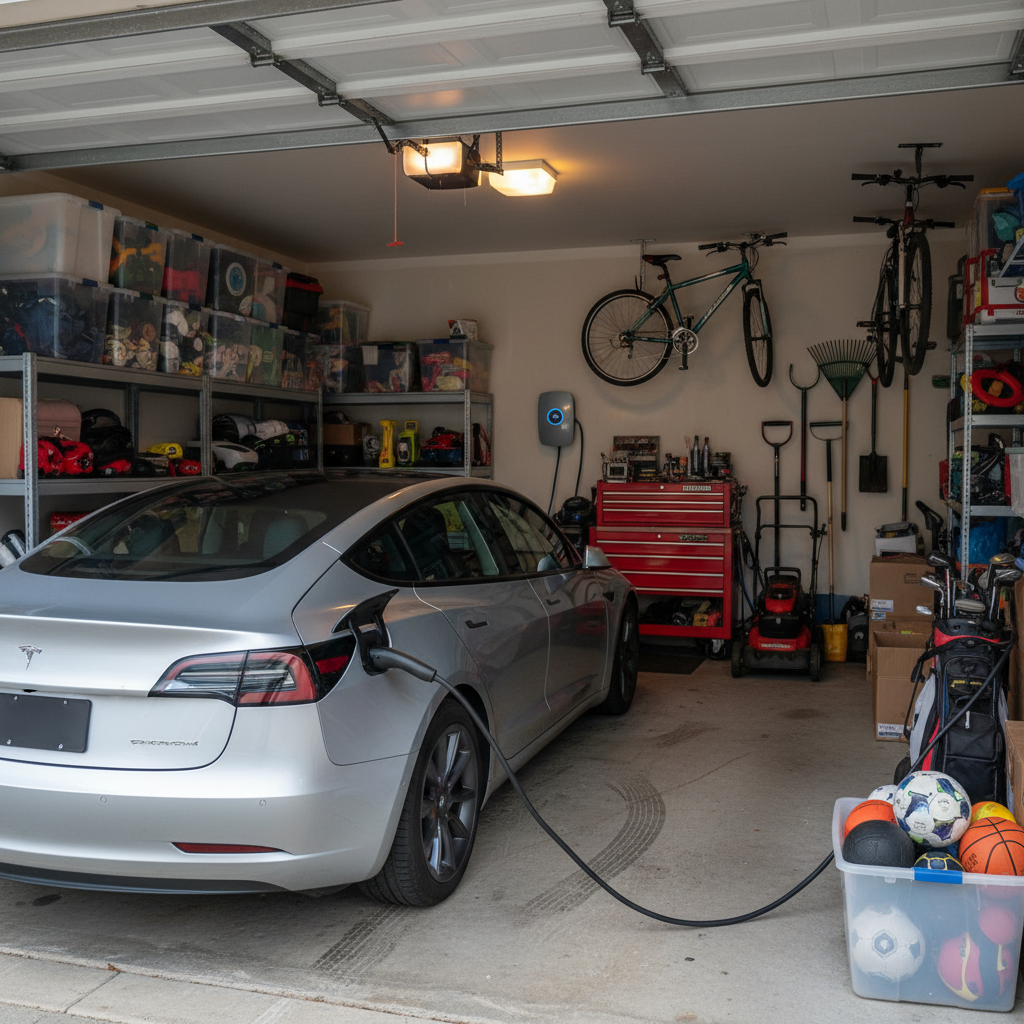
Consumer surveys have long found “range anxiety” to be the number one barrier to EV adoption. A new Telemetry market research report by VP Sam Abuelsamid provides new insights into the question, and points to an often overlooked EV charging challenge: the garage.
While the buildout of DC fast chargers makes the headlines, nearly all EV charging still takes place at home. AC charging accounts for an estimated 80 percent of EV charging sessions, with a majority of those chargers located at a single-family residence. A new study by the National Renewable Energy Laboratory (NREL) found 42 percent of homeowners have access to an electrical outlet that could support level 2 (240-volt) charging in a space where they could park their EV.
That number would increase dramatically, to 68 percent, if households were to clear space in their garages and park their vehicles in the right place. Abuelsamid estimates “90 percent of all houses can add a 240 V outlet near where cars could be parked.” Parking behavior, “namely whether homeowners use a private garage for parking or storage, will likely become a key factor in EV adoption.”
If current garage users parked their vehicles instead of storing items, the number of residences with available EV charging would increase from 31 million to more than 50 million homes. Including homes where charging is possible with new wiring, more than 72 million households could eventually support EV charging. That figure exceeds Telemetry’s high EV penetration forecast for 2035, which projects 33 million to 57 million US EVs.
The Challenge of Charging Capacity
The challenge is that charging capacity does not necessarily mean charging readiness. The NREL report also found nearly 34 million residences in need of electrical upgrades to support a level 2 charger. In some cases, that may require nothing more than adding a new wiring circuit to the household electrical panel. Level 2 charging, however, typically requires at least a 30 amp circuit, and upgrades may mean thousands of dollars in new wiring or full panel replacements.
That capacity challenge threatens to derail the other great benefit of EVs: long-term savings compared to gasoline or diesel cars. The additional cost of installing charging infrastructure can add thousands of dollars to the purchase price, and total cost of ownership can quickly approach or exceed that of conventional combustion engines.
Particularly hard hit by the space and capacity challenges are multifamily homes, which house 23 percent of the US population in apartments, condos, and townhomes. Few individual apartment owners have the ability to add chargers on their own. Instead, they must persuade landlords, management companies, or co-op boards to authorize and fund EV charger installation, an uphill battle in many cases.
The cost of such projects is also higher. While homeowners could spread costs over new wiring, multifamily complexes may need to upgrade entire electrical panels to accommodate a pair of shared level 2 chargers. Projects in existing buildings can cost millions. Wiring also needs to be run to distant parking spots, and residents may be excluded from receiving municipal or utility subsidies for charging equipment.
Today, approximately 1 million EV drivers live in multifamily housing, but only 11 percent park their vehicles near an outlet that they can use to charge. Some states are now requiring 20–25 percent of spaces be EV-ready in new developments, but Telemetry projects that the US will only have 6.7 million to 11.4 million EV charging-capable spaces in multifamily dwellings by 2035. That number would still fall well short of demand.
Due to the limitations of home charging, public charging will be important for millions of EV drivers. Telemetry projects that 11.7 million to 14.3 million EV drivers who live in a house will also use public charging in 2035. Another 7.8 million to 8.1 million EV drivers who live in multifamily residences will also rely on public charging.
Supplying the demand for public charging will require the installation of 523,000 to 586,000 DC fast chargers, and another 1.5 million to 1.6 million level 2 chargers, across the US. The installation of such capacity, however, is not without challenges of its own. The grid is already straining to keep up with burgeoning demand, with new AI data centers vying for generation and distribution capacity, which could hold up the construction of large public charging sites.
There’s no doubt that electric vehicles are the future of driving, but the path to EV domination in the US is not as simple as it might seem. Millions of homes have the theoretical capacity for EV charging, but garage clutter, expensive electrical upgrades, and the unique challenges of multifamily housing could stifle sales. Even a dramatic expansion of public charging may be insufficient, as supply may not meet demand within the next decade.
One thing is certain: EV charging will become as much a conversation at the kitchen table as in boardrooms or state capitols.